

May 19,2026
Category:Company News
Upgrading Lithium Battery Charging Safety: A Manufacturing Facility Case Study with Professional Charging Cabinets
1.Background
With the widespread adoption of lithium-ion batteries in industrial environments, charging safety has become a critical concern. This manufacturing facility operates multiple electric forklifts and AGVs, requiring a centralized charging area.
However, the original setup revealed several risks:
Simultaneous multi-device charging with fluctuating electrical loads
Lack of fire-resistant physical isolation
Limited capability to detect early battery abnormalities
Industry data indicates that 67% of lithium battery fires occur during charging, prompting the company to upgrade its safety infrastructure.
2. Application Scenario
The project involves:
Forklift charging stations (8–12 units)
AGV charging zones
Battery maintenance workstations
The previous solution relied on standard sockets without dedicated safety systems.
3. Solution
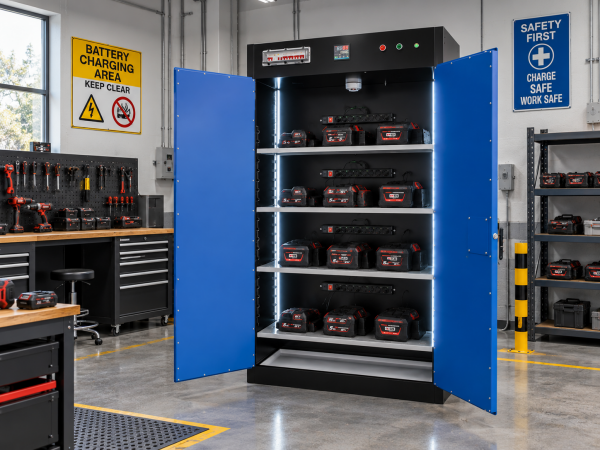
Professional lithium-ion battery charging cabinets were introduced, integrating the following systems:
Intelligent Charging Management
Real-time monitoring of voltage, current, and temperature
Automatic power cutoff under abnormal conditions
Temperature Monitoring
Multi-point NTC sensors (±1°C accuracy)
Instant alarm for temperature anomalies
Fire Suppression
Built-in aerosol fire extinguishing system
Response time < 3 seconds
Independent cabinet-level suppression
Smoke Detection & Ventilation
Early smoke detection
Forced airflow design (bottom intake + top exhaust)
Structural Design
Cold-rolled steel (≥1.0 mm)
Fire-resistant coating
Protection level: IP54
4. Key Specifications
Temperature accuracy: ±1°C
Fire suppression response: < 3 seconds
Material: Cold-rolled steel ≥1.0 mm
Protection: IP54
Ventilation: Forced convection
5. Results
After implementation:
Charging areas became independent safety-controlled units
Early detection of thermal and smoke risks improved
Fire risk shifted from reactive to preventive management
Compliance with internal safety audits was strengthened
6. Client Feedback
The client noted:
Stable operation across multiple battery types
Improved safety management processes
Clear technical compliance during inspections
7. Conclusion
This case demonstrates that integrating professional charging cabinets enables structured risk control in lithium battery charging environments.
Rather than being an optional upgrade, such systems provide multi-layered protection through measurable technical parameters, supporting safer and more compliant industrial operations.

+86 18061900446 /+86 510-88784568
Wuxi Shuangqiao Industrial Park, Xishan Dist., Wuxi city, Jiangsu province.